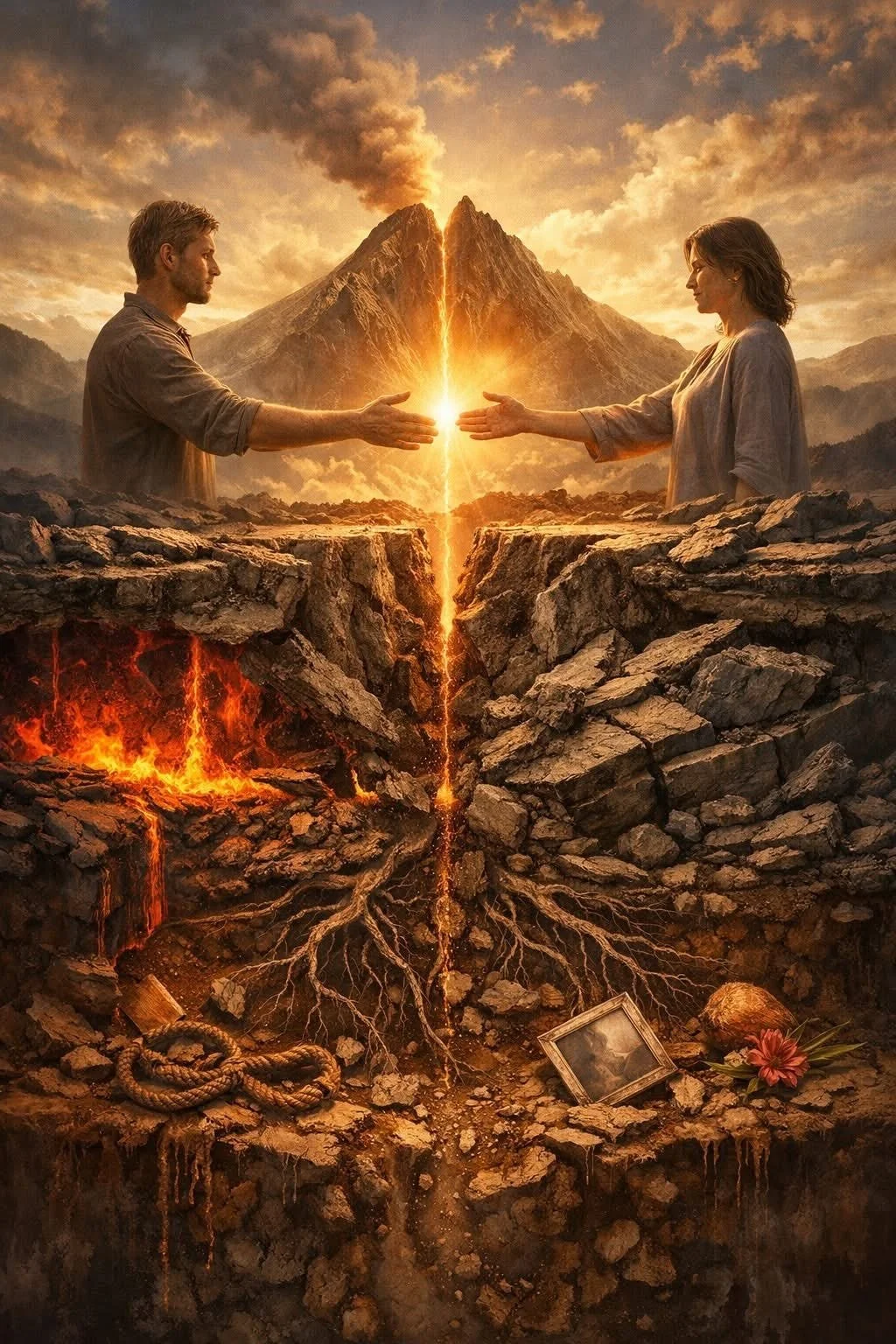
Mountain of Forgiveness
Forgiveness, an easy word to say, a difficult emotion to grasp. Forgiveness isn’t hard because the emotion is complicated. It’s hard because the letting go feels like losing our last piece of protection.
Conflict and the need for forgiveness arises from the twin mountains of right and wrong. The two mountains rise the moment a wound occurs. One mountain says: “I was right.” The other says: “You were wrong.” Between them stretches a valley of tension, the emotional rope that gets pulled back and forth. Maybe that’s where the saying “Is this the hill you want to die on?” comes from. The question challenges us to examine whether the mountain we are defending is worth the cost of the conflict it sustains.
Mountains are born from tectonic plate clashes or volcanic eruption. Volcanic mountains form when pressure builds beneath the surface until it explodes. Tectonic mountains form when two plates collide and push upward. We get so focused on the emotional intensity of how the mountain was created that we loss site of the displaced earth and where the dirt came from. The mountain is dramatic, while the displaced earth is quiet, but the displaced earth is where the buried truth lies and the original injury lives.
In my experience, the people who trigger us the most are the ones who mirror back the part of ourselves we haven’t yet made peace with. If we were to examine a lifetime of challenging people and what emotions were bubbling up in those conflicts, we start to see a pattern. Across a lifetime, the common denominator in all our most painful conflicts is not the people, it’s the emotion they awaken in us.
The emotion is the pattern, not the person. The emotion is the key to freedom. When we stop asking, “Why are these people like this?” and start asking; “What emotion do they awaken in me, and where have I felt this before?” everything changes. Because then the conflict stops being about them. It becomes about our liberation. The answer will never live at the top of the mountain; it can only be found in the valley.
I would like to share what forgiveness looks like from the perspective of an Empath and Medium. From the Medium and empathic perspective, conflict feels like a game of tug-of war. When a soul releases their end of the rope at death the living are left with three options. Stand our ground holding one end of the rope with an unfinished story, put down the rope and call the match a draw, or simply forgive.
When someone triggers us, we are not reacting to their behavior. We reacting to the echo of a past wound from a parent, a partner, a betrayal, a childhood pattern, or a survival strategy. The person becomes a hologram of the original injury. The traits we judge most harshly in others are often our own dormant strengths.
• Someone’s arrogance mirrors our suppressed confidence
• Someone’s selfishness mirrors our chronic over giving
• Someone’s boundarylessness mirrors our own fear of saying no
• Someone’s intensity mirrors the power we were taught to hide
My daughters from my first marriage cannot understand how I could forgive their father who was abusive and withholding. I could see, feel, and acknowledge the pain and rage that lived within him from extreme childhood trauma and understood how it reflected in me, I put down the rope. I could see that his mother spent years poisoning his mind with weaponized narratives about how his father was abusive, had chosen to abandon him, didn’t love him or how he was “just like his worthless father”. She was a person incapable of love but the need to be right and win the tug of war meant that her son was the rope. He didn’t become a father; he became a replica of the story he was told and never questioned. In the 10 years we were married, neither of us ever really saw one another, it took breaking that bond to truly stand in the light and see one another the way we were, not as the ghosts from our pasts. We didn’t feel the need to forgive because we both put down the rope and were able to come down from the mountain.
This story is not about me being a model of forgiveness. It’s about how anger feels in my body. It’s about understanding that the emotion is not the story, it’s the signpost directing me to the mine field of wounds to which I hold the deed. The minefield belongs to me, not the people who trigger it.
Harm matters. Wounds matter. But the emotion that rises in me because of that harm is the doorway to the part of myself that still needs healing. We are not erasing the past, but we are allowed to integrate it. The real story is to give ourselves permission to bind our wounds, disarm the mines and allow a shift in the frequency of what we attract. Because we will continue attract people and situations that validation the existence of our mountain and the need for a mine field.
Once the minefield is disarmed, the pattern dissolves and the mountain stops calling climbers.
The real story is about who needs forgiveness. Not those who have caused harm. The real forgiveness is internal, not external. Forgiving others is often impossible when the wound is fresh, deep, or repeated. But forgiving yourself is always possible.
Forgiving yourself for not knowing better at the time, staying longer than you wish you had, believing someone else’s story about you, carrying wounds that weren’t yours, bracing in ways that protected you, reenacting patterns you didn’t yet understand and being human in the middle of a generational storm. Self forgiveness is not a moral act. It is a release from self punishment. Because in the Light we are all Love.